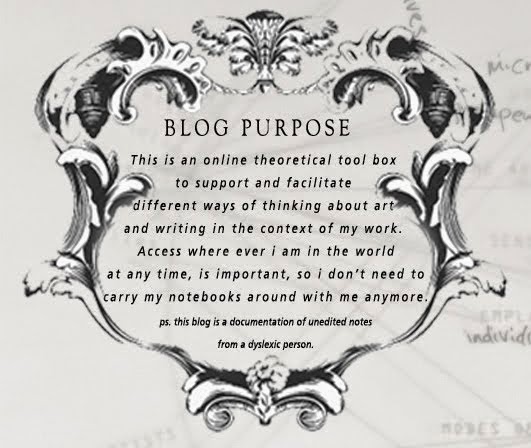
blog purpose

blog purpose
Showing posts with label social sculpture. Show all posts

Saturday, 5 March 2016

CONSTRUCTING ATMOSPHERES


CONSTRUCTING ATMOSPHERES
TEST SITES FOR AN AESTHETICS OF JOY by Margit Brünner


She writes about:

CONCEPTS OF REALITY | ATMOSHERES | BECOMING | HABITAT.  SPINOZA’S GEOETRY | WHAT IS THE BODY | AFFECTING AND BEING AFFECTED | DEGREES OF KNOWLEDGE AND TACTICS OF JOY.  CLIMATES OF JOY | CREATING ATMOSHERES | EXPRESSIVENESS AND BODIES MOVING MAKING ATMOSPHERES. ATMOSPHERIC PERCEPTION | NUANCES AND INTUITION | DRIFT | AND TURBULANCE AND SABOTAGE.

This book deals with my research into atmospheres and the spatial nature of joy.  From a decade of investigations into how places condition emotional responses keeps
evolving as an inquiry in an ever-transforming subject. she gives her account of her
arts-practice and uses this as a theoretical framework for the production of a joyful consequence.  Most of her research into atmospheres has been done through the ‘production of joyful consequences”.

Before becoming a book, Constructing Atmospheres – Test-sites for an Aesthetics of Joy, was a PhD thesis entitled, Becoming Joy: Experimental Constructions of Atmospheres,
Her message:

“The consumer culture has spread around the world, with more
than two billion people now considered to be part of the global
consumer class. This cultural system encourages people
to define their happiness and success through how much they
consume. But on a finite planet, this system is maladaptive
and threatens to cause significant disruptions to Earth’s climate
and ecosystems, and subsequently to human civilization.
If we do not shift to a new cultural norm in the coming decades,
achieving a sustainable society will remain out of reach”.


“BRISK UP JOY’
Peg Rawes
Margit Brünner’s poetic travels through buildings, cities and outback land show us how life is composed of incremental, fleeting and imaginative states of joyous transience.  A figure disappears out of a window, sleeps with suitcase on the public steps of a cultural centre, lies head-first into a yellow dust-grass landscape, or stands as a speck of colour within the visual field. Figures of disappearance perhaps, but for Brünner these are atmospheric compositions of ‘what a body can do’.  performative wanderings – her ‘joy-lines’ – with vocabularies of
‘natural’ and ‘imaginative’ geometries that are retrieved from the philosophical writings of Baruch Spinoza and Henri Bergson, Brünner summons a practice that is composed of a plenitude of bodily, environmental, urban, ad-hoc and quotidian singularities

the body is always situated within a mobile ‘atmosphere’ of material change:
light, vegetation, weather, urbanism and the visual vocabulary of the performer are
co-constituted to form a relational set of spaces, habits and rhythms.

Her event-drawings draw our attention
to the internal imaginative and material integrity of a composition, which we might
interpret as hidden stories of political and cultural signification that form the non-places..

Spinozistic understanding that joy registers as a fleeting moment of
change or dierentiation, unlike the urgent directional impulse or repetitive intensity of pursuits of pleasure that modern drives of desire tend towards. Instead, in these durée, potentia is not sublimated, but constitutes a vocabulary of body-atmospherics which express an ontology of processual life.

Small, ephemeral and insignificant detail such as dust, specks

She appreciates Spinozistic understanding that joy registers as a fleeting moment of change or differentiation. Unlike the urgent repetitive impulse of intense pursuits of pleasure that modern drives us to and where mass culture and twenty-first century urbanism or ‘non-human’ land leads us towards. Instead, in these durée, potentia is not sublimated, but constitutes a vocabulary of body-atmospherics which express an ontology of processual life.
How do specific chosen site relate to the self? How do these site construct the self? How do they interplay with site and environment, through visual art practice?

I propose, in accordance with the Worldwatch Institute’s view, that to liberate happiness from its commercial value and retrieve joy within being may lead to more creative and satisfactory ways of living…to prioritise joy (without and because
of reason) over other aims may in fact contribute to the development of a more ethically and ecologically sustainable society p13

I think: Her hypothesis is that joy is the centre of to bring forth relationships to environmental circumstances?  Her work is a passage between two concepts of spatial reality examined through arts-practice.

WRITING ATMOSPHERES
She has invented a small number of words, neologisms, retaining (and finding joy in) her own logic of language, between languages. From time
to time there is evidence in the writing of this language not being my first language,
which potentially has the effect of evoking an atmosphere of a third language - or a
coming into ‘view’ of the tone of both languages at once.

This book addresses the production of collective spaces suggesting that the
processes of atmospheric exploration are concrete spatial productions.  She has always engaged in a sustained enquiry into the invisible and transient factors that influence the individual character or atmosphere of specific architectural and urban spaces.  She believes to view space is an ‘occurrence’ that emerges from the present moment.  Examining how atmospheres might relate to concrete forms

Glossary:

ATMOSPHERIC COMPOSITIONS-
PEU À PEU’ – p13 means little by little.in french
‘PRACTICAL’ SPATIAL INTERVENING’- addressing strategies for more sensitive ways of engaging with(in) specific physical environments.
ATMOSPHERE-  
MANOEUVRING ATMOSPHERES’ – by consulting thinkers and practitioners from different fields of knowledge to challenge concepts of spatial reality, to investigate it through visual art, consepts of social sculpture,
POETIC TRAVELS,
PERFORMATIVE WANDERINGS,
NON-TELEOLOGICAL EPISODES,
EVENT-DRAWINGS - visual translations of emotional and psychological ‘affect’ into ‘atmospheres’.
‘MINOR GEOMETRIES’ - understood to be composed of the natural rhythms and speeds of change that, for Brünner, constitute worlds of atmospheric inhabitation.
DURÉE, POTENTIAL – duration of the potential line breaks through the long term and structure of history.

UMWELTS AND ATMOSPHERIC HABITATIONS  - rare rhythmic geometries
of what the body can do?
UMWELTS: German for environments. UMWELTEN means the world as it is experienced by a particular organism
TEST SITES- could be the marquee, salon test sites?
SOCIAL COLLECTIVE FABRIC – is what humans contribute positively to the quality of public space.
ATMOSPHERIC REALITY’- interdependently shared collective nature, through explorative experiments.  expression in performative, art-based drawing, as well as in ordinary daily practices that are equally important.  Human investment into joy.
JOY – an internal activity.
THE SPINOZIST- a fleeting moment of change or differentiation.
OPEN-ENDED EXPERIMENTATION – are her continual insights into the relation between architecture, site and emotional or psychological
atmosphere


QUESTIONS for her research (may be good inspiration for salon questions?):

1. How does the experiencing subject resonate with and within a place? She provides a ‘taste’ of atmospheres on p22
Or, How are affecting and being affected mutually operating between site and self?

2. How does one attain an ‘atmospheric state’ as a precondition to explore the issue of the reciprocal exchange between affecting and being affected?

3. How does one navigate as atmosphere within atmospheres; that is, how does
one orientate oneself in a world of resonances as distinct from a world of objects?

4. How can I ‘follow’ the processes of resonance and can they ever really
be ‘represented’ through a visual arts practice?

Wednesday, 19 November 2014

SOCIAL SCULPTURE


SOCIAL SCULPTURE
“ Art as an instrument for consciousness rather than just for attention” Shelley Sacks.
A philosophy of freedom and transformation, and allowing things to unfold and giving direction work together. 
A thinking that could revive social life through an artistic impulse.  Abolishing the separation between intellect and psyche, art and life – paradox that everyone confront when approaching their work in this way.
Seeing difficulties as resources


Social sculpture: creative strategies to come into dialogue with oneself, as we engage we gain new experiences. Is about developing our insights. It is about building new capacities to deal with challenges, can activate, call and plead with us, they don’t have to be a duty or a responsibility. How do we develop our ability to have the capacity to challenge? “ We need to find a way to see our ideas” Beuys.

Working with the ‘entrails’ of ‘internal space’, how do we interprate feelings and emotions, ‘internity’, how do we express ourselves in codes? How do we show human intimacy? How can we mobilise and externalise internal intimacy? Experiential freedom?

It is A perspective of seeing relationships between positive and negative, self and others as a realistic whole.

Socrates: Creative midwifery
Where art and dialogue brings new things to birth.
Rebirthing of new ideas, new organs of perception. Inner technologies Inner and outer connections.
The wound.


Poetic continents – psyche and consciousnessare most important to nurture and unfold.
Poetics of internal and external.Nourishing all those sharing the same path through different disciplines and fields.  Emphasising the difference between an enlivened experience of being rather than a dulled one.
Aesthetic is not defined by style but as  a means for developing a fuller understanding or ourselves.

TERMINOLOGY
Meaningfully share
Art action
Artist as agents for change
Transformative thought
Transformative process
Collective process
Mindfulness
Activate ones inner field
Develop capacities
Social ‘processworks’
collaborative actions
Anti capitalist practice
Invisible materials

Different forms of knowing
Expanding awareness of the senses.
Active listening.
Directional forces
Reassurance rather than persuasion.
Inspiration and imagination/ intuition as forms of thought.
The land of encountering the other. ( Atlas p78) 

Eco-citizenship
The relationship between individual and collective
Freedom and responsibility
Renewable energies
Rethinking progress
Plastic processes
Materials v immaterials


Autonomous Zones

Difficulties as resources

Non material forces

Anti extreme capitalism

Capacity building
Internal mobilisation
Methods of enlivenment
 
GLOSSERY:
DEATH THAT KEEPS ME AWAKE
Joseph Beuys and Rudolf Steiner. Foundations of their thoughts.
By Wolfgang Zumdick
AADR

SEELISCH: Soul, spirit, psyche part of us that is not physically visible.
RICHTKRAFTE: The restoring force’. Direct creativity and freedom to unfold things, give direction to our thinking and shape our world. ‘
GEIST: a consciousness that encompasses mind, culture consciousness and spirit.

GOETHEAN METHODOLOGY:
JOSEPH BEUYS: explored the ‘third road’ between capitalism and socialism, a free democratic socialism.
WOLFGANG ZUMDICK: poetic continents.
RUDOLF STEINER: phenomenology of the mind.
SHELLEY SACKS AESTHETIC: developing a fuller understanding of ourselves in the world. Aesthetic and anaesthetic –
MEISTER ECKHART:
WALDORF SCHOOLS
JACOB BOHME:
SCHILLERS philosophical writings that bridge ‘feeling and thought’, ‘body & mind’. Sensuous knowledge.
FREDRICH HOLDERLIN poems and reflections.
SCHELLING & NOVALIS romantic ideas.

SYMBIOTIC WORLD: diverse organisms that live together.


Hidden forces & invisible forces that govern the physical realm.

Three different capacities of the psyche: Thought | Feeling | Volition
Anthroposophy: Spiritual science. (Geisteswissen shaff) the opposite of Natural science. Needing to find ways to balance and work with these dualities, these two opposites.
Artistic process: as an inner force, comes from an angelic realm.
An esotericism: steiner’s philosophy of freedom.
Conscious transformer: someone who uses the astral, etheric and physical body to increase powers of the mind and reason and to help develop self-reflection.
The substance of perception: dreams, imagination, concepts, ideas, and hallucinations are objects of perception. An esotericism
Euryhmy: where vitality of soul is enhanced.
Hidden forces: of a spiritual nature, macroscopic components of the physical body.
Homologous worlds: between the worlds of above and below.
I: ones will. The world of the will and intuition.Imagination: an analogy to the process of creation.
Mana’s connection: the union of these three bodies that enables us to connect with original transcendental essence of our existence and enhances our human capacity for empathy….also could be described as Sanskrit atma.
Macroanthropes: to understand the world through self reflection, self knowledge? If I can understand myself myself then I can understand the world. Understanding the world through self knowledge.
Mench: human being
Metaphysics as a science: to see the spiritual dimension, the spiritual dimensions  or angelic realms.
Monism: a denial of duality between spirit and the world, matter and mind. Only one supreme being exists, only believing in science (Julian)
Noetic: mystical experience, cosmic, invisible phenomena, a sense of revelation.
Noumenon: knowable by the senses Kantien word.
Organs of perception: imagination| inspiration | intuition
Res Extensa: latin for extended substance of a thing. From Rene Descortes.
Res Cogitans: Corporeal substance both cogitan and extensa become a radical dualism both manifestations of divine thought p36.
Natural sience:
Etheric body:
Astrol body:
Physical body:
Volition: the power of using ones own will, the act of willing, resolving and choosing.

Sensory and extra sensory perceptions:

Forces of the Cosmos

Seraphim: closest to god. Spirit of love.
Cherubin: also closest to god. Spirit of love who creates order, beauty and harmony.
Thrones: spirits of Will, impulse of volition.

Spiritual powers of wisdom, spirits of love
Kyriotetes: closesct to humans, bottom of the Angel pyramid.
Dynamies and Exusiai: spirits of personality
Archais: All the spirits of personality
Angels: are the forces behind and within humans. Can be the force that brings light/life into our being.
Hyreaches : Angels that are the universes I, who are responsible for creation, they make up heaven and the celestial sphere of god. These are active in shaping the world.

JOB :
When other people impose/set work out for you to do. When tasks are set by other people for you to adhere to and having to do what you are told in order to pay your bills, a paid position of regular employment that is usually bland and unfulfilling.
It attends to fundamental basic human needs to exist – bills paid, a basic roof over my head, basic food and clothes to survive in this modern world. Loss of creativity to oneself.
Pain, stagnant, solitary, meaningless, disconnection, dislocation to ones self.

CAREER: A specialist professional lifework that gives a sense of wellbeing, fulfilment, contentment, excitement and purpose. A career makes one thrive everyday. A career  enables a more deeper and meaningful connection to ourselves and the world around us. I see my creativity and innovation as a by-product of my happiness. Pleasure, sense of flow, growth, endless possibilities, meaningful, flourish. Enlivenment.

INTER-RELATING JOB and CAREER:
Inter-disciplinary practice:

Being imaginative with your own career path to sustain your future is essential to contemporary life now. Being adaptable is a survival strategy for transformation, growth and wellbeing.

Inter-relating a career and job can be a contemporary living solution to sustain a main income and sanity in an imaginative way. By being able to sustain this kind of work to pay my basic bills is essential to wellbeing. With out this approach I would hate my job and find it difficult to stay with it and stay emotionally and psychologically healthy.  This approach can opened up other doors and avenues that are really exciting and can expanded into new creative opportunities, avenues and specialisms.

Discovering a way to connect the reality of a job together with a Career is very rewarding and can develop into a niche and a way of being in the world.  It practices the ability to respond and grow to a rapidly changing world. It opens up new awareness and respect for things that need to be done. It offers an effective alternative way to rethink life through art (cross disciplinary practice). It makes one more conscious of what we can do and how it can benefit others. This method of working can develop new forms of engaging us and shaping our lives and other peoples lives.
It helps us to think in an unfixed, mobile and fluid way.
This method of working gives people new opportunities to work in unusual ways, different realms of prefesssionalism and bring together people who would not normally meet.
Re-evaluating meanings like ‘capital assets’, ‘Progress’, ‘profit’, ‘success’.


If I look at ‘capital assets’ and ‘progress’ outside the fixed definitions of their meanings, can i shift what is important to be human, more psychi-social based.

CAPITAL ASSETS:
Assets owned by a person, for investment.
Invisible assets: adaptability for investment in the future, experiential assets and the way we think, our values and attitudes, decisions we make, our sense of freedom rather than financial that do not thoughtlessly exploit and damage all life forms. The things I own inside myself that makes me. It is that defines me. What can I give back? What can I give back to the world in return?For me, Capital assets are also that are heart based, brings harmony to a state of mind, something that brings a state of flow to ones life. Something that breaks me free from conventional thinking, reawakens desires to expand the imagination, something that allows us to accept and celebrate our human limitations. When an inner harmony is reached. Have i moved out of restrictions, have i blurred lines, been spontanious, appreciated and achnowledged the flawed and irregular and incomplete.  This could be a lens for me to look at artworks too..

PROGRESS:
A practice of freedom not just in the individual human being but exploring the relationship of the individual to the collective. Shaping new forms of communities that depends on responsible individuals, to develop new understandings of ‘progress’ and shape non-exploitative relationships to other forms of life.  Embracing insecurities and activating my curiosity.  Cherishing new challenges and seeking the value in the challenges.  Developing own capacity’s for exchanging and sharing. Expanding relationships to place, being connected in the moment and the surroundings.

 HOW SOCIAL SCULPTURE QUESTIONS THINGS:
1.    What can our work offer us for inspiration?
2.    Can we use difficulties and resources for this inspiration?
3.    How can this connection between work and career develop ?
4.    In what ways could this connection advance social and economic understandings of the subject?
5.    In what ways does this connection maker you mobile, free standing, self sufficient and local?
6.    How does this overcome and illuminate numbness, alienation, isolation, displacement, the overlooked, and the imperfect?
7.    What is the outcome of playing into imaginative ideas and spontaneous actions.
8.    How can this move away from systems based on wages for labour and over production?
9.    How does this develop internal relationships with oneself and others.
10. How can this inter-disciplinary work  have an impact socially and ecologically?
11. In what ways can this method of working shape other peoples lives?
12. Why am I doing this, not just asking what is the cause and effect?
13. How does this develop our senses of touch|seeing|smelling|sense of movement|subconscious|speech|listening|state of being|exchange between two people|attitudes|values|
14. How does this link to connections between freedom and responsibility?


_____________________